
 English
 العربية
 Čeština
 Dansk
Dansk
 Deutsch
 Español
 Suomi
Suomi
 Français
 Bahasa Indonesia
 Italiano
 日本語
日本語
 한국어
한국어
 Nederlands
 Polski
 Português
 Română
 Русский
 Svenska
 Türkçe
 Tiếng Việt
 简体中文
简体中文
How to Find Trending Topics on YouTube
Discover rising video ideas using YouTube signals, Google Trends, competitor research, and free trend-finding tools.
You discover rising topics by checking search suggestions, exploring YouTube Charts and Studio Trends, and monitoring competitor channels. Tools like YouTube trend finders can make this research faster. These methods help you understand where audience interest may be heading before a topic becomes crowded.
Instead of relying on guesswork, you compare signals from searches, recent videos, and viewer activity. Publishing at the right time helps your video reach people as their interest begins to grow. Keep monitoring these signals to find relevant topics for your next video. Let's understand each method to find trending topics on YouTube in detail.
Key Takeaways
- You can spot rising topics by watching YouTube search suggestions, yet these clues work best alongside other reliable research methods.
- Google Trends compares relative interest over time instead of showing exact search counts, so use it strictly for pattern reading.
- When a competitor's video clearly beats their normal baseline, it may signal rising interest, but strong views are not proof.
- SmallWebTools YouTube Trend Finder streamlines country-specific research, though titles, thumbnails, and descriptions still carry far more weight than video tags.
- Some trends fade within hours while others build for weeks, so match your production timeline to the topic's natural speed.
Effective Methods for Finding Trending Topics on YouTube
Strong trend research works best when you combine several signals instead of trusting one shortcut. Each method below shows a different layer of audience interest, so together they help you spot momentum earlier and judge it more carefully.
Use YouTube Search Suggestions to Discover Rising Topics
YouTube search suggestions can help you discover useful topic ideas tied to real viewer behavior. However, autocomplete does not work as a perfect early-warning system because predictions also depend on similarity, location, broader search activity, and sometimes personalization.
A simple process makes this method far more useful.
- Open YouTube in an incognito window and type a broad niche phrase slowly. This can reduce the effect of your past behavior, though it will not make results completely raw or neutral.
- Watch which longer phrases appear more than once as you test close keyword variations. Repeated suggestions may point to active interest, but they should be treated as clues rather than final evidence.
- Search the most promising phrases and study the top results carefully. Look at upload dates, view patterns, title styles, and content angles to see whether newer videos are gaining attention.
- Save several phrase variations instead of one exact keyword. Some rising topics take days or even weeks to show up clearly in autocomplete, so comparing multiple searches gives you a better picture.
Analyze YouTube Trending Videos and Popular Content
YouTube removed the general Trending page and Trending Now list in July 2025. That means trend research now depends more on current discovery surfaces like YouTube Charts, Gaming Explore, the Trends tab in YouTube Studio, and Shorts trend pages.
These sources help you study what already has visible momentum.
- Check YouTube Charts for your target country when your niche fits music or other chart-supported categories. Charts show country-based popularity, which makes them useful for spotting broad interest within a specific market.
- If you work in Gaming, open Gaming Explore and study which titles, events, updates, or creators are pulling unusual attention. Game updates and seasonal events often trigger sharp topic spikes.
- Use the Trends tab inside YouTube Studio if you have access to it. This area can help you explore searches and topics connected to your audience, which is far more useful than chasing random viral content.
- Compare thumbnails, titles, formats, and comment themes across high-performing videos. You are not looking for one magic template; you are trying to see repeated audience interests and content patterns.
Use Google Trends to Find Growing YouTube Searches
Google Trends is one of the best free tools for spotting movement around a topic. Still, it does not show the exact search volume. It shows sampled and normalized interest on a 0–100 scale, which helps you compare relative momentum.
Use it as a pattern-reading tool instead of a volume counter.
- Open Google Trends and switch the search type to YouTube Search. That filter matters because web search behavior and YouTube viewing behavior often move in different ways.
- Compare the same term across several time ranges, such as seven days, thirty days, and twelve months. This helps you separate a short spike from a topic with recurring or growing interest.
- Study related topics and related queries for deeper angles. If you see a “Breakout” label, it means the query grew by more than 5,000 percent compared with the previous period.
- Validate every promising trend against your niche and audience needs. A rising term can look exciting on the chart, yet still bring weak results if it does not match viewer intent.

Monitor Competitor Channels for Emerging Topics
Competitor channels often reveal audience shifts before broad trend tools catch them clearly. When viewers suddenly respond to a certain topic, format, or framing style, similar channels usually show those changes in their recent performance.
You can turn competitor research into a steady trend radar.
- Build a list of channels that share your audience size, niche, and content style. Very large creators can distort the picture because their brand power alone may drive strong views.
- Compare recent uploads against each channel’s normal baseline. A video that substantially outperforms the channel’s usual performance may be worth investigating because it can reflect stronger audience interest.
- Look beyond raw views and check upload timing, thumbnails, titles, traffic clues, and comment quality. Strong views help, but they do not prove demand by themselves because many factors influence performance.
- Track repeated topic wins across several channels instead of reacting to one outlier. When multiple creators see unusual traction on a similar idea, the signal becomes much stronger and more reliable.
Use a YouTube Trend Finder Tool
A trend finder tool saves time because it organizes trending video data in one place. Instead of jumping across pages and categories, you can review country-specific results quickly and identify topics worth deeper research.
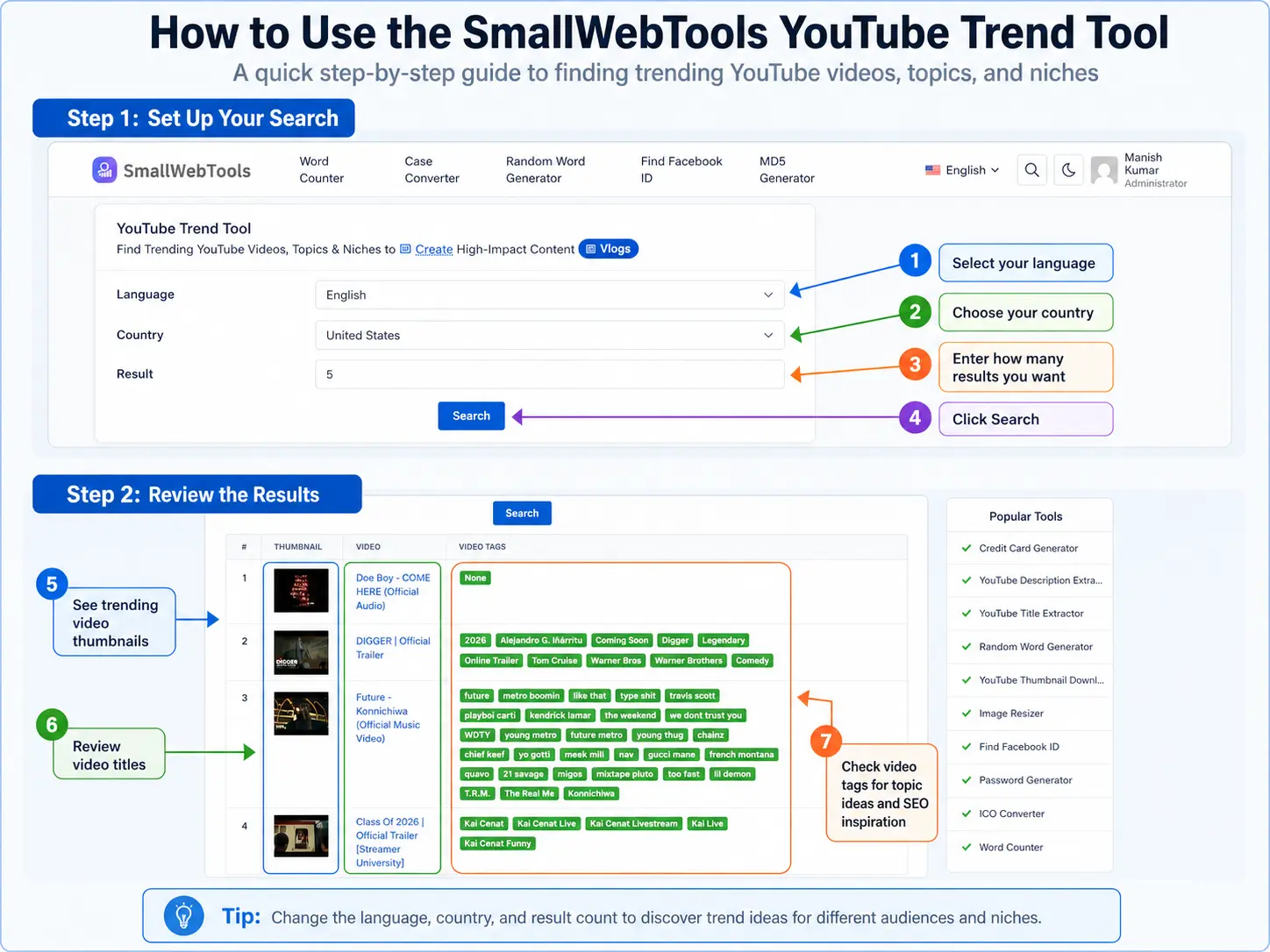
SmallWebTools YouTube Trend Finder makes that workflow simple.
- Open SmallWebTools YouTube Trend Finder and choose the language and country you want to research. This setup helps you focus on the audience market that matters most for your channel.
- Select the number of results you want to review, then run the search. A compact list works well for quick checks, while a larger list helps when you want wider pattern analysis.
- Study the returned titles, thumbnails, and video themes first. These elements usually tell you more about current audience appeal than tags alone because YouTube relies heavily on packaging and viewer response.
- Use the tags as supporting context, not as a shortcut to ranking. Tags can still help with misspellings or topic framing, but titles, thumbnails, descriptions, and content quality carry more weight.
How to Check If a YouTube Trend Is Worth Following
Finding a trend is only the first step. Before you invest time in scripting and editing, you need to test whether that topic fits your audience, your timing, and your channel’s real strengths.
Use these checks before you commit.
- Look for consistent signs of growing interest across more than one source. A topic becomes more promising when search suggestions, competitor gains, comments, and trend tools point in the same direction.
- Ask whether the trend fits your niche naturally. A topic may be popular overall, yet still pull the wrong audience if it feels forced beside your usual content.
- Review performance signals with balance instead of using one metric alone. High views with lower comments do not automatically mean clickbait because some formats attract quieter viewing behavior.
- Judge your production speed honestly before you move forward. A decent topic can still fail for you if you cannot publish while interest is still building.
How to Find Trending Topics for YouTube Shorts
Shorts trends often move faster than long-form video trends, but their timing is not fixed. Some formats peak in hours, some keep growing for days, and others return in waves over several weeks.
That makes regular monitoring more important than rigid rules.
- Scroll the Shorts feed daily and note repeated hooks, captions, formats, or visual styles across different creators. Repetition usually signals growing audience appetite, especially when the pattern appears in several niches.
- Check your Shorts analytics for sudden changes in impressions, views, or traffic sources. A spike shows stronger distribution or audience response, though it does not confirm broad platform-wide testing by itself.
- Watch short-form trends on other platforms as early inspiration, not guaranteed forecasts. Ideas from TikTok or Instagram Reels sometimes carry over to Shorts, but the transfer never happens automatically.
- Compare competitor Shorts against their usual short-form performance. When a topic, editing style, or hook consistently beats their normal range, you may have found a trend worth adapting.
How to Find Trending Topics in Your YouTube Niche
Broad viral topics get attention, but niche trends often bring better viewers. They match your channel more closely, face less competition, and create stronger watch intent because the audience already cares about the subject.
Use focused research to uncover those smaller opportunities.
- Spend time in niche communities such as Reddit threads, Discord groups, forums, or creator comment sections. These spaces often surface questions and frustrations before they become searchable video topics.
- Track product launches, updates, seasonal events, patch notes, policy changes, or industry news. In many niches, these moments trigger predictable waves of curiosity and search behavior.
- Run your niche keywords through Google Trends and SmallWebTools YouTube Trend Finder together. One tool shows relative interest patterns, while the other helps you inspect trending video examples currently.
- Ask your own audience what they want next through comments, polls, or community posts. Your viewers often reveal micro-trends early because they are already close to the topic.
How Early Should You Create Content Around a YouTube Trend?
There's no magic clock for trend timing. Breaking stories demand a quick response within a few days. Evergreen niche trends reward patience because you can build deeper, more valuable content over one to two weeks. The sweet spot depends on your production speed, the competition level, and how fast audience interest is climbing. Rush only when the topic has a short fuse. Otherwise, take the time to craft something worth watching. Speed wins some races. Quality wins the long game.
Conclusion
Finding trending topics on YouTube before they become viral takes sharp observation and steady research. You need to compare signals, question assumptions, and choose ideas that fit your niche instead of chasing every spike you see. Search suggestions can help. Google Trends can reveal relative momentum. Competitor research can uncover early audience shifts.
SmallWebTools YouTube Trend Finder can speed up the process by showing country-specific trending content in one place. Put these methods together and you stop guessing. Start with one niche topic today, test the signals carefully, then use SmallWebTools YouTube Trend Finder to turn that research into your next smart video idea.